Tuesday, September 22, 2009

I've Loved You So Long (2008)


(Il y a longtemps que je t'aime, directed by Philippe Claudel, France, Germany).

The best performance in a film by an actress was not nominated for an Oscar in 2009, but should have been. In a film career playing upper crustic British ladies with couture and hauteur to match, Kirstin Scott Thomas turned 360 degrees and gives an emotional slow-burn performance as an ex-convict reuniting with her sister after an absence of fifteen years.

At first glance, meeting her sister Lea (Elsa Zylberstein) in the airport from England, Juliette is emotionally detached, oddly cool. Lea is also preoccupied with her two adopted Vietnamese daughters and her rather boorish academic husband Luc (Serge Havanacius), as Lea proclaims they are "a real Bennetton family". In the first part of the film, Juliette is rather remote, nearly one of the walking wounded and Scott Thomas plays her with certain brusque touches, shielding her pain until she seems to reawaken from her burnt out state at a party with Lea and Luc's friends.

At the center of the film's plot is the desire for the two sisters to reconnect, to take up broken bonds of family ties after too long of an absence. Juliette does not try to hide why she was in prison and tries to pick up her life while her past continually keeps her back emotionally and behaviorally. When she eventually decides to strike out on her own, after a few false starts (sleeping with a dull macho man, getting thrown out of a job interview by her honesty), she seems to reawaken, to become a full person instead of maintaining the facade of "L'Absente" - the absent one (as she was called in prison).

Her transition is rather moving even though there is an eleventh-hour confrontation in the film between the sisters over why she was in prison. Claudel seems to not know where to go in terms of concluding scenes or of ending this movie. While "I've Loved You So Long" is not exactly a masterpiece, it is an emotionally bare portrait of a woman trying to come to grips with her life and attempt to move on. Kirstin Scott Thomas gives a remarkably poignant and ultimately winning performance and is the real reason to see this film.

Saturday, October 11, 2008

The Last Command (1928)


(Directed by Josef von Sternberg, 1928, USA)
(Notes from the 46th New York Film Festival, 2008, Part 2)

Emil Jannings was one of the great stars of the silent and early talkie cinema. In my mind, he will be forever associated with F.W. Murnau's silent version of "Faust" playing Mefistofeles, as the downsized hotel porter in Murnau's "The Last Laugh", as the jealous husband in Dupont's "Variety" and von Sternberg's later "Der blaue Engel" ("The Blue Angel"), the film that made Marlene Dietrich a worldwide superstar overnight. Also he was the first actor to win the Academy Award in 1929 for this film and for the (unfortunately) lost silent film, "The Way of All Flesh".
It was interesting that the NY Film Festival would present a restored lovely 35mm print of this film, with a score by silent movie music vets Alloy Orchestra.

The rather convoluted plot concerns a prologue with William Powell as a director casting for a film on the Russian Revolution; while leafing through 8 x 10 glossies, he finds a photo of an old man and wants him for an extra. This leads to a search through a rooming house and a twitchy old man (Jannings) gets the call. He decided to go to Hollywood Central Casting, c. 1920's There is a superb tracking shot of extras going from window to window getting various bits of costume. When someone questions the old guy about a medal he's wearing, he replies he received, he replies "From the Tsar!" After a bit of teasing and tag with the medal, the plot develops to a long flashback back to Tsarist Russia pre-revolution and the old twitcher was a top general in the Tsarist army, and the director (Powell) was a Russian theatrical director suspected of being an anarchist, along with his beautiful sidekick Natalya (the lovely Evelyn Brent).

The fairly melodrammatic plot pits the eventual seduction to power of the lovely Natalya, who enjoys her role as a Tsarist general's mistress. Once the revolution happens though, she reveals her true feelings for the pompous codger, saving him from an anarchist's bomb aboard a train, but not before his humiliation before the revolutionaries. Saved from destruction, (from Natalya's intervention) he develops his facial tic while realizing he is responsible for Natalya's death.

The film flashes forward to the bleak present, wherein the director (Powell) goads the general to his final humiliation in a film studio, the 'last command' of the title.

Josef von Sternberg's films were usually celebrations of the grittiness of life or of decadence ("The Blue Angel", "The Scarlet Empress", "The Shanghai Gesture"). "The Lost Command" is as melodrammatic as most silent movies can be, but the performances of Evelyn Brent and Emil Jannings make the film, as well as the director's visual style. While not great cinamatic art, Sternberg's film compresses quite a lot in its 88 minutes runtime.

Summer Hours (L'Heure d'Ete)


(Directed by Olivier Assayas, 2008, France)
(Notes from the 46th New York Film Festival, 2008, Part 1)

Since New York's Lincoln Center is completely dug up from construction, screenings of the New York Film Festival were held at the huge movie barn of the Ziegfield, the Walter Reade theater and as usual, opening and closing nights at Avery Fisher Hall (home of the NY Philharmonic). And tix were usually hard to get for opening, centerpiece and closing night of the Festival. So me and an enterprising friend settled for some festival faves, mostly of a French variety.

L'Heure d'Ete, Olivier Assayas's latest film (and second in a series made by other world directors for Paris's Musee d'Orsay) is an intimate story of a French family coming to terms with basic life issues: in this case, the closing of a summer house in the South of France and the mortality of a matriarchal figure (Edith Scob) who intends to leave her family affairs in order before she dies. This includes discussing with her oldest son Frederic (Charles Berling) where to place some of the rare objets d'art: a Corot painting, and various pieces of rare furniture, and closing the summer home. Indirectly we see the various other family members: Adrienne (Juliette Binoche) a fashion designer living in New York City and Jeremie (Jeremie Renier) who runs a sneaker factory in Shanghai, China.

The second part of the film concerns the settlement of affairs after the matriarch's sudden death, family infighting over the house and belongings and the eventual closing of the house. Life moves on and the epilogue to this quiet film is a farewell: the grand-daughter has a blow out summer party with her friends and gives this small film a bittersweet coda.

This is not a major work by Assayas, but a chamber piece with a variety of different emotions at play: memory, mortality, and decisions of family heritage all work themselves out. The explosions are merely verbal sparring matches, but the film on the whole is rather lovely to watch, making this blogger envious for a summer place, albeit on a smaller scale. Recommended. B+

Monday, August 11, 2008

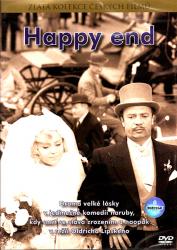
Happy End (1966)


(Directed by Oldrich Lipský. 1966, Czechoslovakia)


The mid-1960's Czech "New Wave" produced some great directors like Jiri Menzel (Closely Watched Trains, Larks on a String); Milos Forman (The Loves of a Blonde, The Firemen's Ball), and Vera Chytilová, the director of the feminist film Daisies, a film remarkably ahead of its time. And then there is Oldrich Lipský, the director of, among other things, "Happy End", the first complete feature film to be filmed totally backwards, where even the dialogue is, yes, backwards.

Not to be confused with the musical Happy End by Bertolt Brecht/Kurt Weill, Lipsky's film is a bold conceptual experiment: a film where the entire mise-en-scene is shot backwards. Not only is the story backwards, the main actor recites in voice over an alternative story to the reversed story we are seeing: this film goes back and forth simultaneously. Or perhaps one of the greatest Dadaistic filmic experiments ever seen, who knows?

The story is a standard jealousy triangle between a butcher, his airheaded wife and the man who comes between them. Needless to say, it doesn't end happily but thanks to the magic of editing (and some silent movie type backwards gags), the film does end happily, hence the title.

The voice-over narration is completely and ridiculously in-sync with the alternate story: murder and death are reversed instead of proceeding in linear fashion: one sequence has the narrator explain (during a funeral) "That's when we planted Grandpa, but he came back" and, in the next scene Gramps is alive and well. The film itself is a curio and it's earthy humor doesn't lag at 71 minutes. For a surrealistic tour-de-force, Happy End delivers. Backwards.

Friday, July 4, 2008

Encounters at the End of the World (2007)


(Directed by Werner Herzog, USA, 2007)


What better way to spend a long hot summer day than being in a semi-crowded theater watching a documentary about the South Pole? And what better tour guide than Werner Herzog, giving a sardonic voice-over to the proceedings?

This, the latest chapter in the (as one internet wag called it) "Herzog versus Nature" series of documentaries is one of this year's most enjoyable films: rather oddball and surprising. While giving laconic comments about the environment and the people he meets (the "encounters") in Antarctica, Herzog reveals a world that is rapidly changing as the threat of global warming encroaches.

The beauty of this world is revealed through the amazing cinematography of Peter Zeitlinger: either going under the surface of the polar ice caps to reveal some of the bizarre underwater denizens that live in sub-zero temperatures or filming the barrenness of Antarctica as a surrealistic snow-covered landscape, the photography is breathtaking.

Herzog's off camera delivery was rather poignant in certain places: showing the last outpost of the failed Shackleton exploration as a "turn of the century supermarket frozen in time" or the absurdist peril of a penguin heading away from its flock to certain death; when he wasn't being sardonic and making fun of the oddballs met on the way. Yet, he adds, he didn't want to do a standard "Discovery Channnel" documentary: he has succeeded in bringing a little known part of the world to the screen in all its latent, bizarre glory.

Thursday, May 1, 2008

Wetherby (1985)


(Directed by David Hare, UK, 1985)


A young man crashes a dinner party given by a middle-aged schoolteacher for her friends. Being British, they are too polite and all believe he came with or knows someone, hence his presence. The next day, the man shows up again and explains that his attending the previous night's dinner was a hypocritical lie, since he didn't know anyone and they all pretended that they did. He suddenly places a gun in his mouth and commits suicide while the teacher watches in shock.

This is the start of David Hare's film Wetherby, focusing on the aftermath and investigation of the suicide of the young man, John Morgan (Tim McInnerney) and simultaneously an investigation of the life of the schoolteacher, Jean Travers (Vanessa Redgrave).

The main reason to see this film is Vanessa Redgrave's excellent, heartfelt performance as a woman who has, in response to a tragedy earlier in her life, has nullified her feelings to the point where she just simply exists. She proudly declares, at one point in the film that she believes she is alone, not lonely and treasures that fact. The point is that she and the friends around her, the Pilboroughs (played by Dame Judi Dench and Ian Holm) are empty and hurting as well. To get by, there are the dinner parties, the pub drinks that Jean shares with Stanley Pilborough where they play elaborate games of one-upmanship and the endless activities that Marcia, Stanley's wife arranges. Into this arrangement of
her semi-lived life comes Karen, a friend of the man who committed suicide. Karen disturbs Jean with her listless approach to living and disaffection and just hangs on. The investigation becomes complicated with a local constable (Tom Wilkinson) asking too many questions. In flashbacks, Jean reveals that she has had a love affair with a long dead man, who died as a result of a stupid chance of events.

Hare's film owes a lot of its structure to Alain Resnais' Muriel, although not having seen that unavailable film, it is hard to comment on the similarities. Hare's film is quite moving and ambitious, being hard to pin down the central mystery on why a young man kills himself over societal rules, but I almost want to believe that the core of the film is that his act forces the schoolteacher to reexamine her life and somehow move on. As one character says in the film, 'Life is messy'.

This is Redgrave's film, her performance lights it up extremely. With this and Karel Reisz's film of Isadora Duncan, this is her best. See it for her.

Sunday, February 3, 2008

Them! (1954)


(Directed by Gordon Douglas, USA, 1954)


For those of us of a certain age, watching 1950's sci-fi/horror films on television became something of a rite embodying somewhat ecstatic religious heights. Let's see: there were killer shrews, giant behemoths, a rampaging prehistoric lizard imported from Japan and creepy crawly spiders. And also those films involving predatory aliens in all sizes and malevolence. All of them involved either atomic mutilation or consequences of atomic bomb testing or interplanetary exploring (or hazards thereof). The average viewer can read into this the cold-war paranoia of 1950's-1960's Cold War politics: or US against them.

Them! was the first 1950's film to deal with gigantic mutant monsters: in this case monstrous ants irradiated by desert A-bomb testing and is one of the best. The predatory giant killer ants were not seen until midway through the movie and only alluded to by a weird high-pitch electronic signal, or a very high frequency noise.

This is particularly eerie and haunting in the very beginning of the movie, when two cops pick up a small girl in the desert, listlessly wandering around, clutching a doll. She only responds when she smells a beaker of folic acid and screams: "THEM!!!"

That's one of this movie's most effective highlights. One of the cops (played by James Whitmore) is joined by an FBI agent (James Arness) and an eccentric old scientist/doctor (Edmund Gwenn) and his daughter (Joan Weldon). The movie involves the standard plot of tracking the killer ants as they migrate westward to sunny California, after laying waste the girl's trailer and family, decimating a general store for sugar and other mayhem. It is gradually revealed that the ants were the products of atomic testing in the New Mexico desert and along the way, the doctor gives a lecture on ant behavior and organization. If only the Bush administration were so organized...oh wait, take that back.

Now for the ants: before CGI and special effects, the 1950's movie monsters were extra-clunky and completely low-tech: the ants of Them! are basically puppets that don't exactly look like ants, (a bit too many pipe cleaners and puppeteers) but who cares? The movie still is great 1950's escapist fun and easily enjoyable. With a grand showdown in the Los Angeles sewers, how can one go wrong?

Them! is great escapist movie for a dull weekend morning. It is enjoyable as a great nostalgic return to low fi horror.

Last Year at Marienbad (1961)


(L'Annee derniere a Marienbad, directed by Alain Resnais, France 1961)

Last Year at Marienbad is one of the most audacious experiments in post-war film. Alain Resnais' film, based on a script by 'nouveau roman' novelist Alain Robbe-Grillet, dispenses with what we normally expect from viewing a film: a linear narrative or storyline, continuity editing (or having the filmic story make sense) and a story arc: or clear beginning, middle and end. This film exists in some sort of temporary present with echoes of a past that the main characters may or may not have experienced. In the filmic case the 'Man' (Giorgio Albertazzi) trys to convince the 'Woman' (Delphine Seyrig) that they have had an affair, while her dessicated husband (Sacha Pitoeff) looks on in menace and concern. The upper-class elegant milieu and the glamorous emptiness of their surroundings entrap all of them somewhere in post-war Europe (read: an above-ground mausoleum).

The end result is a demanding art film full of ellipses, obfuscation and romantic sentiment of the order of one of Alain Robbe-Grillet's 'nouveau roman' experiments. That it works is due to the directorial eye of Resnais and the sexy, insouciant and mysterious persona embodied in the great French actress Delphine Seyrig.

"Last Year at Marienbad" is a classic of the French "New Wave" cinema, and has been successfully reshown in revival twice (as of this writing) at the Film Forum in New York. It generally polarizes audiences as a real head-scratcher, or "one of the most pretentious movies ever made". For this cinema goer, it will forever show the potential for film, experimental film in particular, long after the blockbusters are forgotten.

Friday, January 25, 2008

Two Women (La Ciociara) (1960)


(Directed by Vittorio de Sica, Italy, 1960)

Turner Classic Movies recently aired this as a selection of John Sayles' favorite movies. I have always been intrigued by this film and in 1960 it won Sophia Loren an Oscar for Best Actress from 1962 - the first time that a foreign actress in a foreign film ever won that award.

Basically, De Sica's story is perhaps one of the great anti-war films and its simple story can be described as an almost feminist 'road movie: Loren plays a young voluptuous widowed shopowner in Rome who decides to leave the city with her teenage daughter as constant bombardment from the Second World War threatens their livelihood. She goes to southern Italy with her daughter and meets a badly dubbed Jean-Paul Belmondo at her relatives' home. Her character frequently vents rather naively on men, and the war. Frequently blunt, Loren gives a great performance: tough, vulnerable and ultimately crushed by the tragic denouement that occurs towards the film's end.

It is a shame that this film is not available on a viewable dvd. There is a rather awful version produced by the Madary company that is a rather muddy VHS transfer, by all means avoid this version. Perhaps the Criterion company will re-release a better version in the near future.

La Ciociara is an adaptation of a novel by the Italian author Alberto Moravia, he was responsible for providing the filmic inspiration for, among others Jean-Luc Godard ("Contempt"/"Le Mepris) and Bernardo Bertolucci, ("The Conformist"). For more information click here.

Tuesday, November 27, 2007

I'm Not There (2007)


A cartoon in a recent New Yorker mag depicted two bums leaning against a wall, one saying "So which Dylan do you want to be?"

Which one indeed...such is the subject of Todd Haynes' audacious film I'm Not There, in which six actors play various aspects of the many personas of Bob Dylan.

I would love to know what Bob Dylan thinks of this film. Todd Haynes has created an audacious experimental film about an icon, which (for me at least) is one of the best American films I'd seen in years, and also one of the most imaginative.

In exploring the various "lives" of Bob Dylan, Haynes imagines and reimagines Dylan as a young black Woody Guthrie-inspired teenager (Marcus Franklin); a sell-out film star (Heath Ledger); a funny interviewee named "Arthur Rimbaud" (Ben Whishaw); a born again lost soul (Christian Bale); a Billy the Kid inspired Old West hero (Richard Gere) and the most inspired casting choice of Cate Blanchett as a "Don't Look Back" mid-1960's Dylan named Jude Quinn.

Needless to say this film is not a bio-pic but a fantasia on persona(s). It doesn't really matter if you don't know much about Bob Dylan's life, but it does help to catch some elusive references (i.e., the collaboration with the Band and "The Basement Tapes" totally eluded me, until a fellow film fanatic brought it up).

The film is episodic and enjoyable while not following a linear narrative. Ideally it should be watched on a late afternoon, and the images pour over you like late winter sun. Enjoy the ride.

Wednesday, October 17, 2007

Une vielle Maitresse (2007)


(Directed by Catherine Breillat, France, 2007)
(New York Film Festival Notes, Part 2 of 2)

"Une vielle Maitresse" is a wonderful period piece directed by Catherine Breillat, who had a modest success here some years ago with the films "36 Fillette" and "Fat Girl".

Based on a novel by the 19th century French writer Barbey d'Aurevilly (best known for "Les Diaboliques" among other works that remain untranslated), the film starts with the legend "A story from the ancien regime" then proceeds to depict a story set in the height of French Romanticism, around 1830's - 1840's. Disconnect starts early in this film. "Une vielle Maitresse" tells of the romantic affair between a dissolute rake, Ryno de Marigny (Fu'ad Ait Aattou)and the wilful Vellini (Asia Argento) that creates problems when Marigny decides to marry Hermangarde (Roxane Mesquida), from a wealthy family. Vellini just keeps popping up during the newlyweds' Normandy home and inadvertently creates devastating consequences for all concerned.

First of all, I liked the period detail in this movie: the two leads are strikingly androgynous: Argento, with her handsome allure is very George Sand-ish and Aattou looks younger, very feminine in features to her character's mannish boldness. The affair is told through a flashback that Marigny narrates to the Marquise de Fler (Claude Saurraute, daughter of the novelist Nathalie Saurraute) and Hermengarde's relative. The witty dialogue throughout this scene is a delight, as well as the sumptuous visual decor and narrative. The two leads have some rather odd sex scenes, but Asia Argento is rather sexy, at times she reminded me of a prettier Anna Magnani; and seems to outshine every scene she's in. The actor playing Marigny, while being overpowered, smiles obligingly.

Four Months, Three Weeks, Two Days (2007)


(Directed by Cristian Mungiu, Rumania, 2007)
(Winner of the Palme d'Or, Cannes Film Festival, 2007)

New York Film Festival Notes Part 1


At the last minute, an enterprising friend of mine took me to the 45th New York Film Festival. Getting past the unfortunate choice of venue (Rose Theater), we saw "Four Months, Three Weeks, Two Days", a Rumanian film that won the Palme d'Or this year at Cannes.

Mungiu's film is set in Bucharest during the waning years of the Ceasescu Regime. Ottila (Anamaria Marinca) is a young student constantly negotiating for things on the black market, especially a treasured pack of Kent cigarettes. The camera relentlessly follows her around in long shot, while she runs around negotiating with a hotel clerk who is rather rude to her; another hotel clerk and a shady businessman. The director spoke before the screening about how he wanted to show everyday life in Rumania during the late 1980's: this is a Rumania where you need to use your i.d. for everything, where you are questioned after dark (especially if you are a woman), and where the bureaucratic order is mind-numbingly enforced.

It gradually becomes apparent what Ottila is really negotiating for: without trying to give too much away, she is attempting to obtain an abortion for her friend Gabita (Laura Vasilu). Since abortions were illegal in the years that this film depicts, it is an act of brave desperation that Ottila performs, involving a shady 'doctor' inappropriately named 'Dr.' Bebe (Vlad Ivanov). The so-called Dr. insults the women when they have failed to comply with his implicit instructions, has a melt-down when it is revealed that the self-involved Gabita is late in term: (hence, the film's title) and then becomes a bit fatherly once the deed is done. Ivanov's performance is rather a short, knock-out performance, equal to Marinca's performance.

Mungiu's film is full of long-shots meant to evoke real-time and becomes a bit more revealing with Ottila's running around, until the last devastating half-hour. I would like to recommend this film, but can't really find the words to describe its simple shocking power. The female friend I saw it with was just as disturbed as I was after the conclusion. Writing about it a few days after viewing it, it's still hard to grasp the apparent simplicity of Mungiu's filmmaking, an apparent simplicity that is devastating to watch in its cumulative effect.

Sunday, September 30, 2007

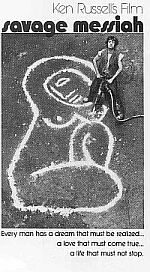
Savage Messiah (1972)


(Directed by Ken Russell, UK, 1972)

"Savage Messiah" is an intriguing film from director Ken Russell. After a trio of great films: "Women in Love", "The Music Lovers" and "The Devils", "Savage Messiah" was a failure. The film depicts a fictionalized version of the pre-modernist artist and sculptor Henri Gaudier (as played by Scott Antony). At the very beginning of Russell's film he meets a Polish poet Sophie Brezska (played by Dorothy Tutin) in the Bibliotheque National in Paris and they lived together in London, he eventually co=opted her name to his, and is now known as Henri Gaudier-Brezska.

If one can get past the annoying British accent of Antony's portrayal of Gaudier, the film is a rather high-spirited portrait of an artist trying to defy poverty and create. While not a strict bio-pic on an artist, Russell tries to give a visual rhapsody of the artist creating in an absolute vacuum, combining a total lack of recognition on the part of British art critics and snobs of the Edwardian period and the existence of an artist's absolute poverty. While not at all true to life, (what Ken Russell movie is?) it is exhilarating to watch, as an invention of one filmmaker's response to an artist he truly admires. The highly visual sets support this, (thanks to Derek Jarman, set designer for this film): several scenes take place in a garret reminiscent of a setting for the "Lower Depths" and a 'Vorticist' nightclub that wouldn't be out of place in a German Expressionist film (say "Cabinet of Doctor Caligari").
Helen Mirren is on hand in one of her early roles as a suffragette, and an unlikely patron of the sculptor.

"Savage Messiah" ends abruptly with the mention of Gaudier's death during the First World War and the camera cuts several times to Brzeska crying and to a memorial exhibit of the sculptures. It's a very moving sequence, visually taking Gaudier-Brzeska's sculptures from the realm of the film into the here and now. The sculptor was one of the more unfortunate casualties from the First World War, he died an early death at the age of 23.

This film deserves to be seen, and is ripe for a re-evaluation, at least as a genuine DVD release. I can't think of any other film on an artist that is so joyful, so crazy and so colorfully vivid as this film.

Sunday, September 9, 2007

Halloween (2007)


(Directed by Rob Zombie, 2007, USA)

Usually I try to never see sequels because I am sure to be disappointed.While having very fond memories of John Carpenter's Halloween (1978), I guess I should have stuck to my basic rule: NO WATCHING REMAKES.

Rob Zombie's Halloween starts off with good intentions, but doesn't go anywhere. Yes, we see the young teen Michael Myers with his unhappy homelife: drunk stepdad (William Forsythe), slutty sis Judith (Hanna Hall), lil' baby Boo and stripper Mom (the ever watchable Sheri Moon Zombie). The first act of the movie focuses incessantly on the young 12 year old Michael Myers and his upbringing: torturing and killing animals and eventually turning on the people who pick on him at school. He comes under the care of Dr. Samuel Loomis (Malcolm McDowell) and eventually is institutionalized after the usual family blood bath. Everyone is killed except for stripper mom and baby. Needless to say, little Mikey is sent to a state hospital for the criminally insane.

Fifteen years later, Mikey Myers gets out to wreak his revenge by going home. There is very little connection to why Michael Myers returns home: he's (I think) looking for the baby girl (?), his sister and doesn't care who gets in his way. Typical slasher mayhem ensues. It's incredibly not interesting.

It was very hard for me to watch this tepid remmake without thinking about John Carpenter's original: with a lesser budget than this movie and practically no special effects. This remake was the ultimate curse of a horror film: it was dull, and just not really interesting, not even in its climax. By focusing on how Michael Myers became the killing machine, the director neglected one basic fact: we want our horror movie killers to be killers, not have some mopey, artsy background, explaining why they did it, what turned them into this....blah blah blah. The final girl was no Jamie Lee Curtis either: in the original, Curtis is resourceful; here in the remake, the girl screams a lot, lets the kids she's babysitting to fend for themselves and you really don't care.

Stick with Carpenter's original, you won't go wrong.

Friday, August 31, 2007

No End In Sight (2007)


(Directed by Charles Ferguson, 2007, USA)

"No End in Sight" is an amazing documentary about the aftermath of the Iraq War, from the US involvement post-9/11/2001 to the current Iraqi Occupation. There are various interviews with former Washington 'insiders': generals, government officials and a few marines, giving their views and insights on the occupation. While wisely not focusing on the reasons the Bush Administration went to war, the documentary instead gives an indictment of the failure of this current administration's foreign policies in regards to Iraq and the calamity that followed: poor planning and bad decisions that led to the intensification of conflicts between Shi'ite and Sunnis and the ultimately ruinous decision to disband (not disbar) the Iraqi military.

It is difficult to watch this documentary and not feel anger and disgust at the incompetence and sheer stupidity of the Bush Administration in allowing Iraq to completely disintegrate into its current fragmented state. Yet, there are clips of Donald Rumsfeld saying that he "doesn't do quagmires" and using the dictionary for the definition of that word. How disgusting is that? Reports are compiled by administration experts and parsed into one page summaries that an arrogant president not only does not read, yet speaks at a news conference that the report information is 'not factual'. One of the most chilling episodes is home video footage of government approved private contractors shooting at Iraqi civilians on a road while Elvis sings "Mystery Train", just another hunting day for Haliburton or other corporate warmongers.

This documentary was shown at the Film Forum, the evening I went there were six people in the audience; in an ideal world there should have been more. This documentary shows what went wrong and, without pointing blame, it gives you the answers for who is ultimately responsible: our no-accountability administration.
It deserves to be seen and given as wide a release as Michael Moore's Sicko.

Lacombe, Lucien (1974)


(Directed by Louis Malle, 1974, France)


Lacombe, Lucien is a powerful study of life under the Vichy Occupation of France, during the waning years of the Second World War. Lucien (Pierre Blaise) is a country hick who tries to get involved with the Resistance and, failing that, goes to work with the local collaborators. Being a young, naive farmboy hick, he does not realize the implications of his actions: the first being that he informs on his old teacher, the one who advised him not to join the Resistance.

The Nazi collaboraters are holed up in decadent surroundings in a provincial hotel, wherein (in on of the early scenes) the wife of a police head is reading the daily mail, consisting of notes from informers spying on their neighbors: to make things ever more surreal, there is a letter from a man informing on himself. Lucien becomes a mascot to them and, with the connection of the son of a French nobleman, meets the family of Albert Horn, a Jewish tailor in hiding. He falls in love with Horn's daughter France and there the complications ensue. Lucien is a blank slate, someone so young and stupidly naive, that he has no conscience or judgement on his actions, he just tries to fit in, allowing himself to be used for an ideology that he doesn't bother to comprehend. Completely apolitical, he doesn't bother to register that his actions are noticed by the Resistance movement that rejected him at the beginning of the film. In the course of the film, his actions are devastating to those around him.

This was Malle's first film about the French Occupation, the other being Au Revoir les Enfants. . While the latter film is rather tender (being based on a sad childhood memory of the director), this film is rather tough, rather ominous and open to interpretation. The Criterion release is rather fantastic, cleaned up but without any extras. Thirty years plus later, this is still an important French film, skillfully done and engrossing to watch.

Friday, August 24, 2007

Band of Outsiders (1964)


(Original Title: Bande a Part, Directed by Jean-Luc Godard, 1964, France)

Band of Outsiders is a happy-go-lucky anomaly among Jean-Luc Godard's early 1960's work, made between Le Mepris (Contempt) and Alphaville. The film is a modified gangster story (based on a crime novel) that never quite seems to take itself seriously and contains numerous inside jokes. Two pals Arthur (Claude Brasseur) and Franz (Sami Frey) persuade a student in their school Odile (Anna Karina) to help them commit a robbery at Odile's aunt's home. Along the way there are a few jokes about film sound (Karina feeds a tiger one hears before seeing); a "moment of silence" in which the film's soundtrack goes literally silent. A few classic moments as well that were shamelessly quoted in later films: a run through the Louvre and the ever fabulous fun sequence of the trio dancing "the Madison" in a Paris bistro, complete with requisite voice-over by Godard himself, explaining each characters interior life.


As an almost frivolous 'stylistic exercise' (think Raymond Queneau), Band of Outsiders is a study of a film, but is enjoyable to watch as the film invents and seems to re-invent itself. Godard would only be this playful again in the later film Masculin/Feminin, and would begin to pursue the (then) fashionable Marxist societal critique of his later 1960's work. At least, Band of Outsiders, (besides giving Quentin Tarantino's production company a name), is a 'transitional' film in the work of one of cinema's true innovators. And Karina dances very well too.

The Criterion DVD release is quite commendable: while not containing the usual 'commentary', special features contain a 'behind-the-scenes' short feature with Godard (which contains the only known footage of the making of "Band of Outsiders"), and interviews with long-time Godard cameraman Raoul Coutard and Anna Karina, as well as a silent movie parodic sequence lifted from Agnes Varda's "Cleo from 9 to 5" starring Godard, Karina and Frey.
Now, if only Rialto Pictures could restore "Une Femme Mariee" life would be ....

Monday, August 20, 2007

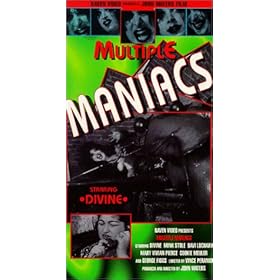
Multiple Maniacs (1970)


(Directed by John Waters, 1971, in lovely Baltimore, USA)

I knew I just couldn't stay away from great trash, so "Multiple Maniacs" was watched again recently, during one of those ever more frequent "there's nothing on TV" nights. As a real cinemaphile, I never saw a John Waters movie until "Polyester" came out with the tacky scratch-n-sniff cards in the early 1980's. I knew right away that Divine was fantastic and I had to see everything Waters did (thanks Steve, I still blame you!). In the words of the late, great Divine: "I've enjoyed every fucking last minute of it!"

This is John Waters' second feature and first talkie with Divine and co. previously there was a short campy film called "The Diane Linklater Story" and the non-sync sound "Mondo Trasho". Divine plays Lady Divine, owning a "Cavalcade of Perversions" overseen by her boyfriend Mr. David (David Lochery) serving as a two-timing ringmaster/emcee. Lochary does a good job trying to entice suburban Baltimore audiences (most of whom play major roles later: Mink Stole, Cookie Mueller, Mary Vivien Pierce) and the sideshow tent focuses on perverted (at the time) acts: two homosexuals engaged in a kiss, a heroin addict going cold turkey, a woman sniffing and licking a bicycle seat and a puke eater (no explanation needed there). The sideshow is just an excuse for Lady Divine to rob the audience (even resorting to shooting a recalcitrant audience member if necessary). Mr. David is about to have an affair with Bonnie (Mary Vivien Pierce)a self-described "auto-eroticist" trying to join the Cavalcade, and Divine tries to keep him in line by telling him he's involved with the Manson family murders, (unsolved at the time of filming), while crashing at her daughter Cookie's apartment (Cookie Mueller), she threatens to tell all. A bar owner (played by Edith Massey in her first Waters film) phones Divine to inform her that her David is fooling around and it sets in motion another cavalcade of perversions involving Divine and the other characters.

Among the many highlights: religious imagery in the form of a little boy dressed ceremoniously as the "Infant of Prague" seen after Divine is raped by a junkie couple (a woman and man in a dress), leading her to a church where she has a 'rosary job' performed by a self-described "religious whore" Mink Stole (don't ask) as the Stations of the Cross are recited. The low rent blasphemy continues as a dream sequence occurs of both "Sermon of the Loaves and Fishes" complete with Wonder Bread loaves, tuna fish cans and later a visual recounting of Christ's crucifixion (with Edith Massey as the Virgin Mother!).


Multiple atrocities abound: Mink and Divine get hassled and then murder a harassing cop, Bonnie shoots Cookie (mistaking her for Divine), Divine kills David and eats some of his entrails, and nearly everyone dies save for Divine who becomes: "A Maniac!" after being raped by a large noisy wooden lobster ("Oh No! LOBSTORA!") To the strains of Holst's "Mars", Divine goes on a Godzilla-like rampage: stealing a car, terrorizing a couple parked on a date, all the while she is dressed in a mink coat and lingerie in what looks like winter. She is finally brought down and shot by the National Guard to the strains of Kate Smith warbling "God Bless America".

This early Waters film is a bit of a satiric time capsule on late 1960's/early 1970's mores, and occasionally works. A lot of the movie is cheap: cheaply shot, acted in one take (with flubbed lines included) and shakily edited. It's not as smooth as later mainstream Waters movies (Polyester, Hairspray, etc.) But there are many endearing moments amid the semi-surreal and campy, sacriligeous plot. The ending I took to be indicative of its time and place, with echoes of 1968 Chicago riots and Kent State. Divine's 'acting' is rather raw here, but you can see the seeds of Babs Johnson or Dawn Davenport in embryonic stage.

It's a fun watch and a must for John Waters fans. It gives a basic blueprint for his later sardonic style, but here it's rather raw. All that and a lobster that creaks like the Coney Island Cyclone.

Thursday, August 16, 2007

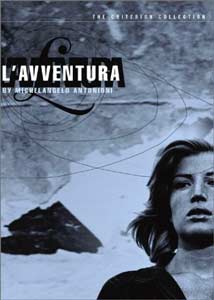
L'Avventura (1960)


(Directed by Michelangelo Antonioni, 1960, Italy)

L'Avventura continues to have a polarizing effect on viewers since its premiere at the Cannes Film Festival 47 years ago: either you like Antonioni's masterpiece or you don't. On the internet movie database page for this film, the plot keywords give it all: unsolved mystery, very little dialogue (a personal favorite), island, missing person, human relationship (perhaps in the plural?) and realization. All of these generalizations just scream out: art house film.

Yes, socialite Anna (Lea Massari) disappears within the first half hour of the film while visiting an island on a cruise with her upper class friends, among them: her fiance Sandro (Gabriele Ferzetti) and her best girlfriend Claudia (Monica Vitti). Her disappearance is never explained, it just happens. Sandro and Claudia remain on the island in an attempt to find her, searching false leads in town; eventually Sandro makes a play for her, Claudia is guilty, and after rejecting Sandro, she decides to be in a relationship with Sandro, he is caught 'in flagrante delicto' by Claudia, and she forgives him.

This synopsis is comically inept, deliberately so (like the plot keywords quoted above). This film is a journey as the title implies, the viewer is along for the ride, as narrative disappears like Anna and Antonioni's style becomes increasingly prevalent during the course of the film. Shots of the barren coast of Sicily are impeccably and beautifully presented, long shots become ordinary and L'Avventura settles into a 'longeur', an epic mood of Italian upper-class 'l'ennui and randomness, nearly shot in real time. At times, on re-watching this film, I felt that Antonioni was attempting to recreate some of the surreal landscapes of the painter Giorgio De Chirico, paintings empty of people, devoid of normal life but containing a focus on absence, therefore rendering the places mysterious. The cinematography by Aldo Scavarda was extremely effective in realizing the dreamlike pace of this film, especially during the search for Anna on the barren Sicilian island. The exterior shots are like a volcanic wasteland, one of the most striking sequences earlry on is of Claudia shouting Anna's name in the rain, surrounded by the rain and rocks.

Monica Vitti's Claudia is an emotional anchor for the film: it is implied that her friendship with Anna might be more intimate, and she is the first one to notice that Anna has disappeared. Her anxiety and fear is portrayed subtly, as well as her disgust initially with Sandro's advances. This is a nuanced performance and Vitti gives a credible performance throughout. I wish I could say the same for the actor Gabriele Ferzetti playing Sandro, although he does seem to come into his own during the second half of the film, his style is a bit too low-key.

One aspect I noticed during this viewing of "L'Avventura" was the way that Antonioni's script focused almost pointilistically on relationships: at the very start of the film, Anna and her father have a tense, inconclusive dialogue, Sandro with Anna before the cruise saying that words are unimportant for them, the casual intimacy mentioned before between Claudia and Anna, the rather callous way that Patrizia parades her affection for other men under the nose of her husband. The subsidiary characters have their moments too: as Sandro follows a lead to a small Sicilian town, the owners of a pharmacy bicker about their memories, you get the feeling that they've been doing it for years and it seems is their only means of communication. One implication I felt on viewing this film is that Antonioni is forcing the viewer to watch the minutiae of daily lives: as this is something perhaps he feels we are programmed into taking for granted. When something happens to disrupt the social fabric: say Anna's disappearance (or in literary parallel Gregor Samsa's transformation), Antonioni seems to suggest life goes on, even with major disruptions. It is rather an existential, cynical view, which is why I believe that only Claudia and Sandro alone from the boating party search for Anna, the others want to get on with their cruise. The other characters are sketchy and seem too self-centered to care for Anna to even bother searching for her, nor (as at the beginning of the film) does Anna care for her social circle and makes it clear (at the very start of the film) that she is rather dissatisfied with her life. Anna's disappearance besides providing the central mystery of L'Avventura, (and the catalyst for the action), is one of the great disruptions in cinema, equivalent to the murder of Marion Crane in Alfred Hitchcock's Psycho: with the main exception that Hitchcock never conceals anything from the viewer in Psycho, Antonioni presents his concealments as matter of fact.

In summary, Antonioni provides us with a film that is open-ended, unresolved. Like most of life, L'Avventura is continuously open to debate and interpretation, after its premiere 47 years ago. How many current films invite us to do that?

Tuesday, August 14, 2007

Pigs and Battleships (1961)


(AKA Hogs and Warships) (Buta to Gunkan, Directed by Shohei Imamura, 1961, Japan)


The late, great Shohei Imamura was one of the leading directors in 1960's Japanese cinema. In a ten year period he directed films as
Pigs and Battleships
; The Insect Woman,
Intentions of Murder, The Pornographers: An Introduction to Anthropology, A Man Vanishes and The Profound Desire of the Gods. As a director whose work has mainly stayed outside of the mainstream due to his critical views of modern Japanese society, his films are rarely shown outside of film classes amd retrospectives. With DVD releases in recent years on the Criterion label of The Pornographers and the later serial killer crime film Vengeance is Mine, hopefully this situation will change, and more audiences will discover the earlier, great films of Shohei Imamura.

Pigs and Battleships is a good example of an Imamura film: at once a critical view of post-war Japan and creeping Americanization (the U.S. occupation in Japan post-World War II). Pigs and Battleships focuses on the lower class: Haruko, trying to keep her guy Kinta from getting involved with the local yakuza who deal in black-market pigs. Kinta is drawn into the gang's plans and finally dies in a tense, noirish shootout complete with a stampede of pigs through the local nightclub district. Haruko herself is no heroine, but will prostitute herself for enough money, including getting gang-raped by three American sailors (with whom she unsuccessfully tries to rip off).


The movie is rather comical despite the bleakness, with elements of black humor and low comedy surrounded by port town seediness. In the end, Haruko does escape but-given the film's milieu - she won't get far before trying her old tricks. The film is amazing in showing the corruption surrounding the young couple, and the characterizations are brilliant. Just don't expect a typical Hollywood ending here, in the world of this film, it doesn't work.