Wednesday, October 17, 2007

Une vielle Maitresse (2007)


(Directed by Catherine Breillat, France, 2007)
(New York Film Festival Notes, Part 2 of 2)

"Une vielle Maitresse" is a wonderful period piece directed by Catherine Breillat, who had a modest success here some years ago with the films "36 Fillette" and "Fat Girl".

Based on a novel by the 19th century French writer Barbey d'Aurevilly (best known for "Les Diaboliques" among other works that remain untranslated), the film starts with the legend "A story from the ancien regime" then proceeds to depict a story set in the height of French Romanticism, around 1830's - 1840's. Disconnect starts early in this film. "Une vielle Maitresse" tells of the romantic affair between a dissolute rake, Ryno de Marigny (Fu'ad Ait Aattou)and the wilful Vellini (Asia Argento) that creates problems when Marigny decides to marry Hermangarde (Roxane Mesquida), from a wealthy family. Vellini just keeps popping up during the newlyweds' Normandy home and inadvertently creates devastating consequences for all concerned.

First of all, I liked the period detail in this movie: the two leads are strikingly androgynous: Argento, with her handsome allure is very George Sand-ish and Aattou looks younger, very feminine in features to her character's mannish boldness. The affair is told through a flashback that Marigny narrates to the Marquise de Fler (Claude Saurraute, daughter of the novelist Nathalie Saurraute) and Hermengarde's relative. The witty dialogue throughout this scene is a delight, as well as the sumptuous visual decor and narrative. The two leads have some rather odd sex scenes, but Asia Argento is rather sexy, at times she reminded me of a prettier Anna Magnani; and seems to outshine every scene she's in. The actor playing Marigny, while being overpowered, smiles obligingly.

Four Months, Three Weeks, Two Days (2007)


(Directed by Cristian Mungiu, Rumania, 2007)
(Winner of the Palme d'Or, Cannes Film Festival, 2007)

New York Film Festival Notes Part 1


At the last minute, an enterprising friend of mine took me to the 45th New York Film Festival. Getting past the unfortunate choice of venue (Rose Theater), we saw "Four Months, Three Weeks, Two Days", a Rumanian film that won the Palme d'Or this year at Cannes.

Mungiu's film is set in Bucharest during the waning years of the Ceasescu Regime. Ottila (Anamaria Marinca) is a young student constantly negotiating for things on the black market, especially a treasured pack of Kent cigarettes. The camera relentlessly follows her around in long shot, while she runs around negotiating with a hotel clerk who is rather rude to her; another hotel clerk and a shady businessman. The director spoke before the screening about how he wanted to show everyday life in Rumania during the late 1980's: this is a Rumania where you need to use your i.d. for everything, where you are questioned after dark (especially if you are a woman), and where the bureaucratic order is mind-numbingly enforced.

It gradually becomes apparent what Ottila is really negotiating for: without trying to give too much away, she is attempting to obtain an abortion for her friend Gabita (Laura Vasilu). Since abortions were illegal in the years that this film depicts, it is an act of brave desperation that Ottila performs, involving a shady 'doctor' inappropriately named 'Dr.' Bebe (Vlad Ivanov). The so-called Dr. insults the women when they have failed to comply with his implicit instructions, has a melt-down when it is revealed that the self-involved Gabita is late in term: (hence, the film's title) and then becomes a bit fatherly once the deed is done. Ivanov's performance is rather a short, knock-out performance, equal to Marinca's performance.

Mungiu's film is full of long-shots meant to evoke real-time and becomes a bit more revealing with Ottila's running around, until the last devastating half-hour. I would like to recommend this film, but can't really find the words to describe its simple shocking power. The female friend I saw it with was just as disturbed as I was after the conclusion. Writing about it a few days after viewing it, it's still hard to grasp the apparent simplicity of Mungiu's filmmaking, an apparent simplicity that is devastating to watch in its cumulative effect.

Sunday, September 30, 2007

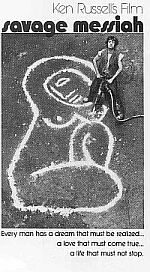
Savage Messiah (1972)


(Directed by Ken Russell, UK, 1972)

"Savage Messiah" is an intriguing film from director Ken Russell. After a trio of great films: "Women in Love", "The Music Lovers" and "The Devils", "Savage Messiah" was a failure. The film depicts a fictionalized version of the pre-modernist artist and sculptor Henri Gaudier (as played by Scott Antony). At the very beginning of Russell's film he meets a Polish poet Sophie Brezska (played by Dorothy Tutin) in the Bibliotheque National in Paris and they lived together in London, he eventually co=opted her name to his, and is now known as Henri Gaudier-Brezska.

If one can get past the annoying British accent of Antony's portrayal of Gaudier, the film is a rather high-spirited portrait of an artist trying to defy poverty and create. While not a strict bio-pic on an artist, Russell tries to give a visual rhapsody of the artist creating in an absolute vacuum, combining a total lack of recognition on the part of British art critics and snobs of the Edwardian period and the existence of an artist's absolute poverty. While not at all true to life, (what Ken Russell movie is?) it is exhilarating to watch, as an invention of one filmmaker's response to an artist he truly admires. The highly visual sets support this, (thanks to Derek Jarman, set designer for this film): several scenes take place in a garret reminiscent of a setting for the "Lower Depths" and a 'Vorticist' nightclub that wouldn't be out of place in a German Expressionist film (say "Cabinet of Doctor Caligari").
Helen Mirren is on hand in one of her early roles as a suffragette, and an unlikely patron of the sculptor.

"Savage Messiah" ends abruptly with the mention of Gaudier's death during the First World War and the camera cuts several times to Brzeska crying and to a memorial exhibit of the sculptures. It's a very moving sequence, visually taking Gaudier-Brzeska's sculptures from the realm of the film into the here and now. The sculptor was one of the more unfortunate casualties from the First World War, he died an early death at the age of 23.

This film deserves to be seen, and is ripe for a re-evaluation, at least as a genuine DVD release. I can't think of any other film on an artist that is so joyful, so crazy and so colorfully vivid as this film.

Sunday, September 9, 2007

Halloween (2007)


(Directed by Rob Zombie, 2007, USA)

Usually I try to never see sequels because I am sure to be disappointed.While having very fond memories of John Carpenter's Halloween (1978), I guess I should have stuck to my basic rule: NO WATCHING REMAKES.

Rob Zombie's Halloween starts off with good intentions, but doesn't go anywhere. Yes, we see the young teen Michael Myers with his unhappy homelife: drunk stepdad (William Forsythe), slutty sis Judith (Hanna Hall), lil' baby Boo and stripper Mom (the ever watchable Sheri Moon Zombie). The first act of the movie focuses incessantly on the young 12 year old Michael Myers and his upbringing: torturing and killing animals and eventually turning on the people who pick on him at school. He comes under the care of Dr. Samuel Loomis (Malcolm McDowell) and eventually is institutionalized after the usual family blood bath. Everyone is killed except for stripper mom and baby. Needless to say, little Mikey is sent to a state hospital for the criminally insane.

Fifteen years later, Mikey Myers gets out to wreak his revenge by going home. There is very little connection to why Michael Myers returns home: he's (I think) looking for the baby girl (?), his sister and doesn't care who gets in his way. Typical slasher mayhem ensues. It's incredibly not interesting.

It was very hard for me to watch this tepid remmake without thinking about John Carpenter's original: with a lesser budget than this movie and practically no special effects. This remake was the ultimate curse of a horror film: it was dull, and just not really interesting, not even in its climax. By focusing on how Michael Myers became the killing machine, the director neglected one basic fact: we want our horror movie killers to be killers, not have some mopey, artsy background, explaining why they did it, what turned them into this....blah blah blah. The final girl was no Jamie Lee Curtis either: in the original, Curtis is resourceful; here in the remake, the girl screams a lot, lets the kids she's babysitting to fend for themselves and you really don't care.

Stick with Carpenter's original, you won't go wrong.

Friday, August 31, 2007

No End In Sight (2007)


(Directed by Charles Ferguson, 2007, USA)

"No End in Sight" is an amazing documentary about the aftermath of the Iraq War, from the US involvement post-9/11/2001 to the current Iraqi Occupation. There are various interviews with former Washington 'insiders': generals, government officials and a few marines, giving their views and insights on the occupation. While wisely not focusing on the reasons the Bush Administration went to war, the documentary instead gives an indictment of the failure of this current administration's foreign policies in regards to Iraq and the calamity that followed: poor planning and bad decisions that led to the intensification of conflicts between Shi'ite and Sunnis and the ultimately ruinous decision to disband (not disbar) the Iraqi military.

It is difficult to watch this documentary and not feel anger and disgust at the incompetence and sheer stupidity of the Bush Administration in allowing Iraq to completely disintegrate into its current fragmented state. Yet, there are clips of Donald Rumsfeld saying that he "doesn't do quagmires" and using the dictionary for the definition of that word. How disgusting is that? Reports are compiled by administration experts and parsed into one page summaries that an arrogant president not only does not read, yet speaks at a news conference that the report information is 'not factual'. One of the most chilling episodes is home video footage of government approved private contractors shooting at Iraqi civilians on a road while Elvis sings "Mystery Train", just another hunting day for Haliburton or other corporate warmongers.

This documentary was shown at the Film Forum, the evening I went there were six people in the audience; in an ideal world there should have been more. This documentary shows what went wrong and, without pointing blame, it gives you the answers for who is ultimately responsible: our no-accountability administration.
It deserves to be seen and given as wide a release as Michael Moore's Sicko.

Lacombe, Lucien (1974)


(Directed by Louis Malle, 1974, France)


Lacombe, Lucien is a powerful study of life under the Vichy Occupation of France, during the waning years of the Second World War. Lucien (Pierre Blaise) is a country hick who tries to get involved with the Resistance and, failing that, goes to work with the local collaborators. Being a young, naive farmboy hick, he does not realize the implications of his actions: the first being that he informs on his old teacher, the one who advised him not to join the Resistance.

The Nazi collaboraters are holed up in decadent surroundings in a provincial hotel, wherein (in on of the early scenes) the wife of a police head is reading the daily mail, consisting of notes from informers spying on their neighbors: to make things ever more surreal, there is a letter from a man informing on himself. Lucien becomes a mascot to them and, with the connection of the son of a French nobleman, meets the family of Albert Horn, a Jewish tailor in hiding. He falls in love with Horn's daughter France and there the complications ensue. Lucien is a blank slate, someone so young and stupidly naive, that he has no conscience or judgement on his actions, he just tries to fit in, allowing himself to be used for an ideology that he doesn't bother to comprehend. Completely apolitical, he doesn't bother to register that his actions are noticed by the Resistance movement that rejected him at the beginning of the film. In the course of the film, his actions are devastating to those around him.

This was Malle's first film about the French Occupation, the other being Au Revoir les Enfants. . While the latter film is rather tender (being based on a sad childhood memory of the director), this film is rather tough, rather ominous and open to interpretation. The Criterion release is rather fantastic, cleaned up but without any extras. Thirty years plus later, this is still an important French film, skillfully done and engrossing to watch.

Friday, August 24, 2007

Band of Outsiders (1964)


(Original Title: Bande a Part, Directed by Jean-Luc Godard, 1964, France)

Band of Outsiders is a happy-go-lucky anomaly among Jean-Luc Godard's early 1960's work, made between Le Mepris (Contempt) and Alphaville. The film is a modified gangster story (based on a crime novel) that never quite seems to take itself seriously and contains numerous inside jokes. Two pals Arthur (Claude Brasseur) and Franz (Sami Frey) persuade a student in their school Odile (Anna Karina) to help them commit a robbery at Odile's aunt's home. Along the way there are a few jokes about film sound (Karina feeds a tiger one hears before seeing); a "moment of silence" in which the film's soundtrack goes literally silent. A few classic moments as well that were shamelessly quoted in later films: a run through the Louvre and the ever fabulous fun sequence of the trio dancing "the Madison" in a Paris bistro, complete with requisite voice-over by Godard himself, explaining each characters interior life.


As an almost frivolous 'stylistic exercise' (think Raymond Queneau), Band of Outsiders is a study of a film, but is enjoyable to watch as the film invents and seems to re-invent itself. Godard would only be this playful again in the later film Masculin/Feminin, and would begin to pursue the (then) fashionable Marxist societal critique of his later 1960's work. At least, Band of Outsiders, (besides giving Quentin Tarantino's production company a name), is a 'transitional' film in the work of one of cinema's true innovators. And Karina dances very well too.

The Criterion DVD release is quite commendable: while not containing the usual 'commentary', special features contain a 'behind-the-scenes' short feature with Godard (which contains the only known footage of the making of "Band of Outsiders"), and interviews with long-time Godard cameraman Raoul Coutard and Anna Karina, as well as a silent movie parodic sequence lifted from Agnes Varda's "Cleo from 9 to 5" starring Godard, Karina and Frey.
Now, if only Rialto Pictures could restore "Une Femme Mariee" life would be ....